From Aqua Guide, the free encyclopedia
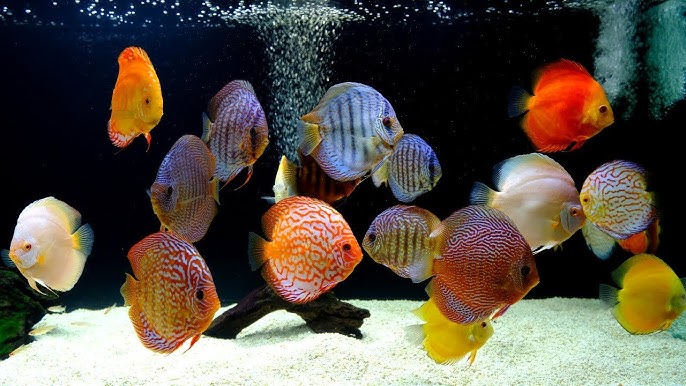
Discus
Symphysodon aequifasciatus
- Temperature
- 28–31 °C
- pH
- 5 – 7.5
- Min. tank size
- 250 L
- Lifespan
- 10-15 years
- Diet
- omnivore
- Care level
- difficult
| Scientific classification | |
|---|---|
| Scientific Name: | Symphysodon aequifasciatus |
| Family: | Cichlidae |
| Origin: | South America (Amazon basin floodplain lakes and slow tributaries) |
| Care Characteristics | |
| Care Level: | difficult |
| Diet: | omnivore |
| Max Size: | 23.00 cm |
| Water Type: | freshwater |
| Temp Group: | tropical |
| Temperament: | peaceful |
| Min Group: | 6+ together |
| Varieties: | The taxonomy is unsettled, which matters when reading strain names. FishBase recognised three species — Symphysodon aequifasciatus, the blue or brown discus of the central Amazon; S. discus, the red or Heckel discus; and S. tarzoo, the green discus of the western Amazon. A 2011 molecular study found five evolutionary groups, and the Catalog of Fishes now recognises four: S. discus, S. tarzoo, S. haraldi and S. aequifasciatus. Habitat differs between them. S. discus is restricted to blackwater; S. tarzoo occurs in both black and whitewater; S. aequifasciatus is a clearwater fish. Captive strains — turquoise, pigeon blood, ghost, cobalt, solid red, snakeskin, checkerboard and many more — derive from wild green, blue and brown discus, not from the Heckel. Decades of selection have produced fish that look nothing like any wild population. Asian aquaculture, notably in Thailand, is a major industry, and the fish has built a collectors' following with shows, competitions and specialist breeders. Practical advice: buy farmed fish from a reputable breeder, and buy the tank and the water sorted before the fish. |
| Lifespan: | 10-15 years |
Quick Tips
- Bioload:Medium to high
- Min Tank:250 L
- Substrate:Bare bottom or fine sand; tall plants/driftwood; warm soft water
- Plant Safe:Plant-safe
- Filtration:High (pristine water; gentle flow)
Discus (Symphysodon aequifasciatus) is a species of fish in the family Cichlidae. It is native to South America (Amazon basin floodplain lakes and slow tributaries). Discus feed their young on their own skin. Both parents secrete a mucus — the hobby calls it discus milk — and the fry graze it directly off their flanks for the first four weeks of life. For the first two weeks the parents stay with them; over weeks three and four they begin swimming away to wean the fry off. The secretion carries key microorganisms across to the young, which is why parent-raised fry survive better than artificially reared ones. Very few fish in fresh water do anything comparable. The genus lives along the margins of floodplain lakes and rivers in the lowland Amazon. Wild fish typically reach 12.3–15.2 cm, though captive specimens have reached 23 cm, and adults weigh 150–250 g. They are highly social — unusual for an American cichlid — occurring in groups that may number many dozens. They are also demanding, and the demands are warmth, softness and cleanliness rather than skill.
Compatibility
- Temperament
- peaceful
- Keep in
- Groups of 6+
- Swims
- middle
- Fin nipper
- No
- Delicate fins
- No
Species similar to Discus
Matched on family, then category, then water type