From Aqua Guide, the free encyclopedia
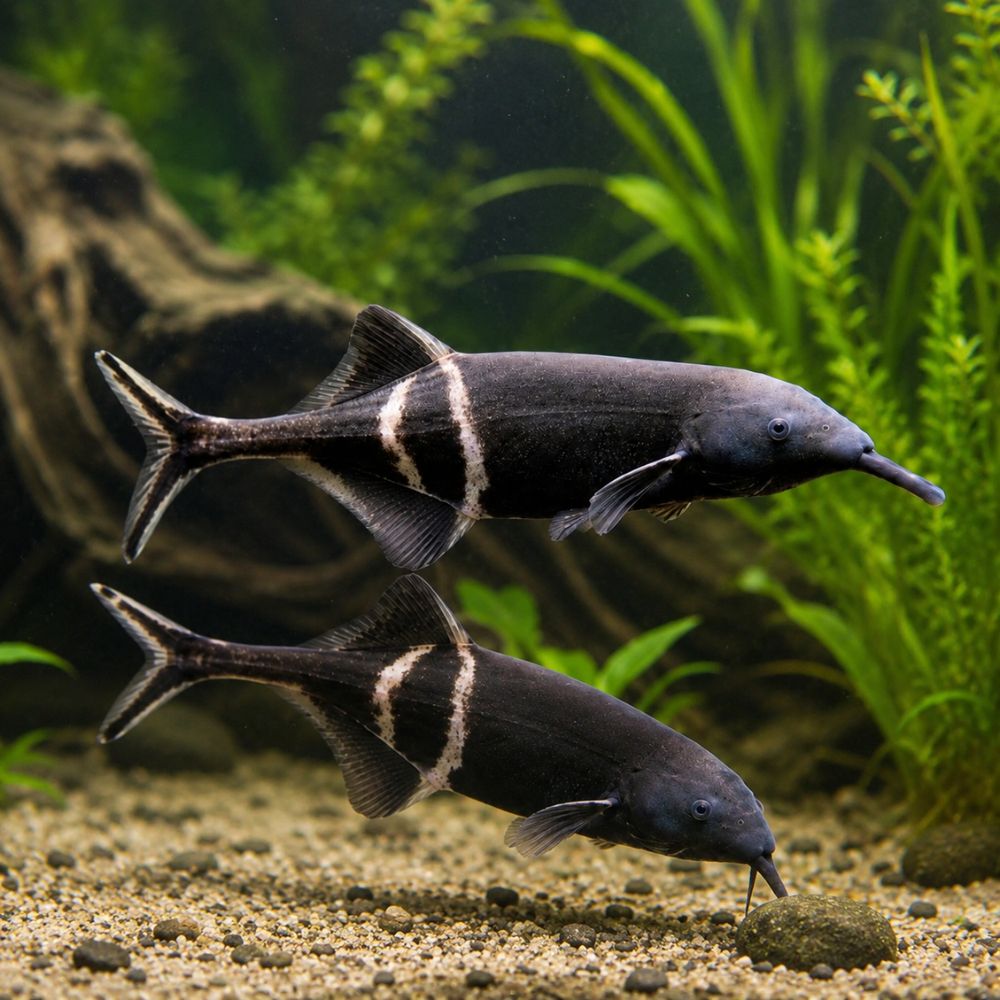
Elephant Nose
Gnathonemus petersii
- Temperature
- 23–28 °C
- pH
- 6 – 7.5
- Min. tank size
- 250 L
- Lifespan
- 6-10 years
- Diet
- carnivore
- Care level
- difficult
| Scientific classification | |
|---|---|
| Scientific Name: | Gnathonemus petersii |
| Family: | Mormyridae |
| Origin: | West/Central Africa (slow, turbid rivers) |
| Care Characteristics | |
| Care Level: | difficult |
| Diet: | carnivore |
| Max Size: | 25.00 cm |
| Water Type: | freshwater |
| Temp Group: | tropical |
| Temperament: | semi aggressive |
| Min Group: | Can be kept alone |
| Varieties: | No cultivated strains and no colour forms — this is a wild-type fish, and almost every specimen in the trade is wild-caught from West and Central Africa. Individual variation in the white chevron markings on the flanks is considerable, and those markings are used to tell individuals apart. The species stands alone in the aquarium trade among a large family. Mormyridae contains around 200 species, and several others reach the hobby occasionally — the baby whale (Pollimyrus and Petrocephalus species) is smaller and more suited to a normal tank, and various Campylomormyrus and Mormyrus species appear under trade names. All are electric, all are nocturnal, and all share the same sensitivities. The African knifefish (Xenomystus nigri) and the black ghost knifefish are sometimes grouped with them as "electric fish", and the black ghost genuinely is electrogenic — but it belongs to an unrelated South American family that evolved the ability separately. The convergence is one of the more striking examples in fresh water. |
| Lifespan: | 6-10 years |
Quick Tips
- Bioload:Medium
- Min Tank:250 L
- Substrate:Soft sand (essential for its delicate trunk); dim lighting, caves and cover
- Plant Safe:Plant-safe
- Filtration:High (pristine, stable, well-oxygenated water)
Elephant Nose (Gnathonemus petersii) is a species of fish in the family Mormyridae. It is native to West/Central Africa (slow, turbid rivers). The elephant nose has the largest brain-to-body oxygen use ratio of any known vertebrate — around 0.6. Roughly three fifths of the oxygen it consumes goes to its brain. In humans the figure is about a fifth. It needs that brain because of how it perceives the world. The fish generates a weak electric field using electrocytes, specialised cells evolved from muscle, and reads distortions in that field through electroreceptors across its body. It uses this to find food, to navigate in dark or turbid water, and to find a mate. The trunk is not a nose. It is a sensitive extension of the mouth, used for self-defence, communication, navigation, and finding the worms and insects it eats. It comes from West and Central African rivers — the lower Niger, the Ogun, and the upper Chari — and reaches 23 to 25 cm. It is aggressively territorial toward its own kind unless the tank exceeds 400 litres.
Compatibility
- Temperament
- semi aggressive
- Keep in
- Can be kept alone
- Swims
- bottom
- Fin nipper
- No
- Delicate fins
- Yes — keep away from nippers
Species similar to Elephant Nose
Matched on family, then category, then water type