From Aqua Guide, the free encyclopedia
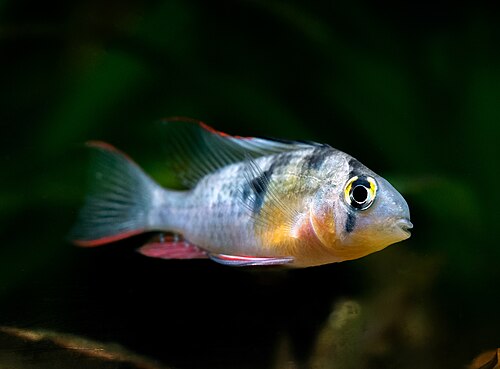
Bolivian Ram
Mikrogeophagus altispinosus
- Temperature
- 24–28 °C
- pH
- 6 – 7.5
- Min. tank size
- 180 L
- Lifespan
- 4 years
- Diet
- omnivore
- Care level
- moderate
| Scientific classification | |
|---|---|
| Scientific Name: | Mikrogeophagus altispinosus |
| Family: | Cichlidae |
| Origin: | South America (upper Madeira basin, Bolivia and Brazil) |
| Care Characteristics | |
| Care Level: | moderate |
| Diet: | omnivore |
| Max Size: | 8.00 cm |
| Water Type: | freshwater |
| Temp Group: | tropical |
| Temperament: | peaceful |
| Min Group: | 2+ together |
| Varieties: | No cultivated strains worth the name, which is a point in its favour — this is a wild-type fish and it has largely escaped the line-breeding that has weakened the German blue ram. Occasional selected lines are offered for stronger red in the fins, and some suppliers distinguish regional forms by collection locality, but nothing is established as a named strain. There is no balloon Bolivian ram, no electric blue form and no long-finned version in general circulation. That absence matters. The commercial strains of M. ramirezi are documented as genetically weak, disease-prone and short-lived, with hormone use suspected in parts of the trade. The Bolivian has not been through that, and it is a substantially more robust animal as a result. Both wild-caught and captive-bred fish are available, and both are hardy. Names in the trade vary — Bolivian butterfly, ruby crown cichlid and altispinosa all refer to this species, and older labels may use Papiliochromis or Apistogramma altispinosa. The closest relative you will meet is M. ramirezi itself, covered separately, and the practical choice between them is temperature and hardiness rather than looks. |
| Lifespan: | 4 years |
Quick Tips
- Bioload:Low to medium
- Min Tank:180 L
- Substrate:Soft sand; planted with caves, flat stones and cover
- Plant Safe:Plant-safe
- Filtration:Moderate
Bolivian Ram (Mikrogeophagus altispinosus) is a species of fish in the family Cichlidae. It is native to South America (upper Madeira basin, Bolivia and Brazil). The Bolivian ram is the ram to keep if the German blue ram has already gone badly for you. It comes from the upper Madeira basin in Bolivia and Brazil and reaches 80 mm standard length — twice the body length of its more famous relative. Specialists describe it as a larger, less colourful fish lacking the blue iridescent markings, and arguably a better choice for less experienced aquarists than M. ramirezi. The colour is subtler and, kept well, genuinely handsome: a soft gold-grey body with a black eye stripe and a black flank blotch, red edging through the fins, and the extended dorsal spines the species is named for. The important difference is temperature. Where the German blue ram needs 27–30 °C (81–86 °F), the Bolivian is comfortable at 24–28 °C (75–82 °F), which is an ordinary community range. It is still a cichlid with standards, and one qualification below is worth reading.
Compatibility
- Temperament
- peaceful
- Keep in
- Groups of 2+
- Swims
- bottom
- Fin nipper
- No
- Delicate fins
- No
Species similar to Bolivian Ram
Matched on family, then category, then water type