From Aqua Guide, the free encyclopedia
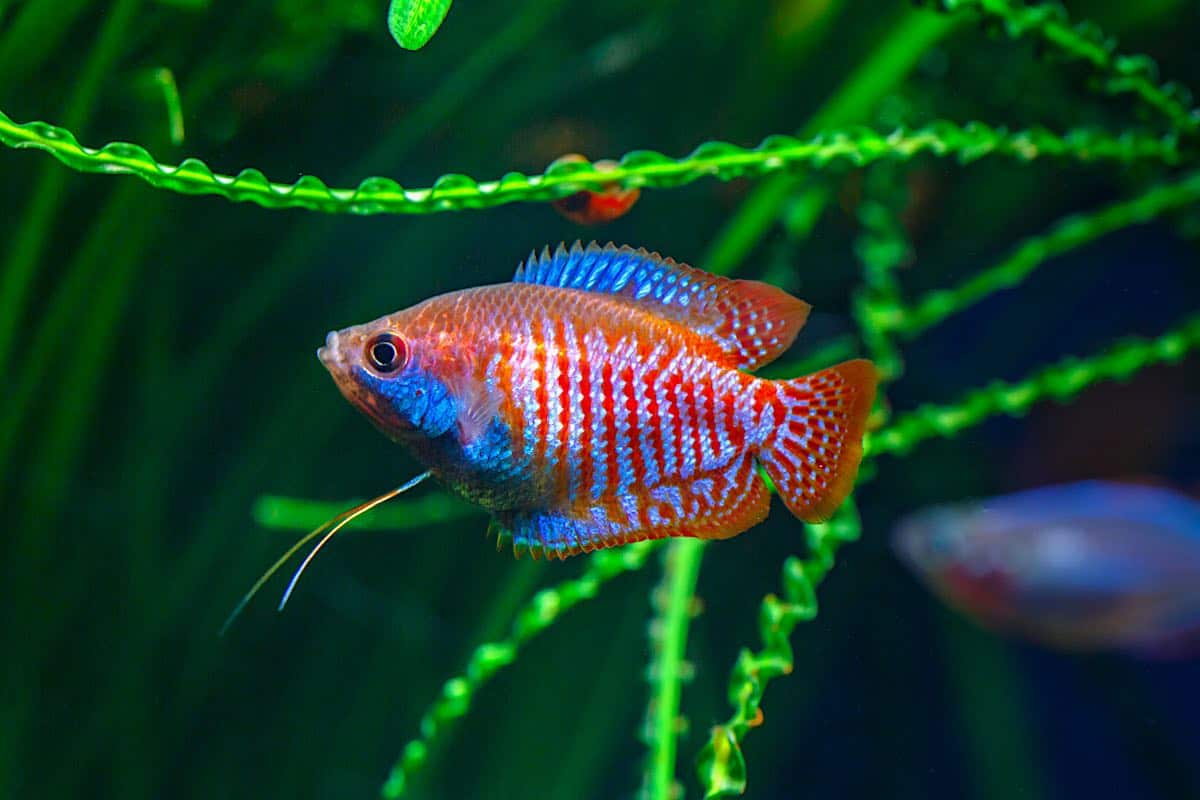
Dwarf Gourami
Trichogaster lalius
- Temperature
- 22–27 °C
- pH
- 6 – 7.5
- Min. tank size
- 60 L
- Lifespan
- 5 years
- Diet
- omnivore
- Care level
- moderate
| Scientific classification | |
|---|---|
| Scientific Name: | Trichogaster lalius |
| Family: | Osphronemidae |
| Origin: | South Asia (India, Bangladesh, Pakistan) slow vegetated waters |
| Care Characteristics | |
| Care Level: | moderate |
| Diet: | omnivore |
| Max Size: | 9.00 cm |
| Water Type: | freshwater |
| Temp Group: | tropical |
| Temperament: | peaceful |
| Min Group: | Can be kept alone |
| Varieties: | The wild-type male — iridescent blue-green with red-orange vertical banding — remains the standard, and several selectively bred strains sit alongside it. The sunset, also sold as red or robin, replaces the banding with solid orange-red. The neon strain intensifies the blue. Powder blue is an almost uniform pale blue with the red reduced or absent. Rainbow and flame forms extend the range further. There is a reasonable argument, made by specialists, that none of the cultivated strains match the natural form for brilliance, and the wild type is also generally the more robust fish. The colour strains carry a practical cost beyond appearance: heavy line breeding is associated with the poor health that dogs this species, and the more intensively bred forms tend to come from exactly the large-scale operations where iridovirus is prevalent. Two related fish are worth knowing. The honey gourami (Trichogaster chuna) is a separate species — smaller, calmer, and not associated with the same disease problem, which makes it the sensible substitute. The banded or giant gourami (Trichogaster fasciata) is a larger relative often confused with a big dwarf gourami. |
| Lifespan: | 5 years |
Quick Tips
- Bioload:Low
- Min Tank:60 L
- Substrate:Dark sand or gravel; densely planted with floating plants and calm surface
- Plant Safe:Plant-safe
- Filtration:Low (gentle flow; access to surface air)
Dwarf Gourami (Trichogaster lalius) is a species of fish in the family Osphronemidae. It is native to South Asia (India, Bangladesh, Pakistan) slow vegetated waters. The dwarf gourami is one of the most attractive small fish in the hobby and one of the most frequently lost, and the reason is not husbandry. It comes from slow, heavily vegetated waters across India, Bangladesh and Pakistan, and reaches about 8.8 cm. Like all anabantoids it carries a labyrinth organ and breathes atmospheric air at the surface. The threadlike pelvic fins are feelers — genuine sense organs the fish uses to touch and taste its surroundings, and you will see it reach out and probe with them. Males are iridescent blue and red; females are a plain silvery grey. The problem is a virus. A 2006 Australian study found as many as 22 per cent of dwarf gouramis exported from Singapore were carrying dwarf gourami iridovirus. It is highly infectious, so far untreatable, and it can pass to other species sharing the water. Buying carefully is the whole game with this fish.
Compatibility
- Temperament
- peaceful
- Keep in
- Can be kept alone
- Swims
- top
- Fin nipper
- No
- Delicate fins
- Yes — keep away from nippers
Species similar to Dwarf Gourami
Matched on family, then category, then water type