From Aqua Guide, the free encyclopedia
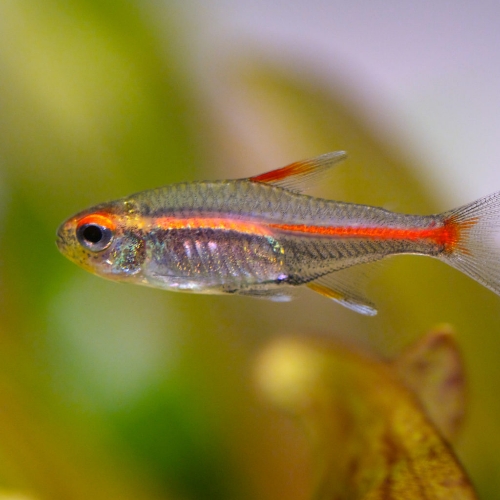
Glowlight Tetra
Hemigrammus erythrozonus
- Temperature
- 22–28 °C
- pH
- 5.5 – 7.5
- Min. tank size
- 75 L
- Lifespan
- 4-5 years
- Diet
- omnivore
- Care level
- easy
| Scientific classification | |
|---|---|
| Scientific Name: | Hemigrammus erythrozonus |
| Family: | Acestrorhamphidae |
| Origin: | South America (Essequibo basin, Guyana) |
| Care Characteristics | |
| Care Level: | easy |
| Diet: | omnivore |
| Max Size: | 4.00 cm |
| Water Type: | freshwater |
| Temp Group: | tropical |
| Temperament: | peaceful |
| Min Group: | 6+ together |
| Varieties: | Sold as the wild form in almost every shop. A long-finned strain turns up occasionally and needs calmer company, since the trailing fins invite nipping from anything less gentle than the glowlight itself. There are no established colour morphs — the orange stripe is the whole point of the fish, and nothing has been bred that improves on it. The species is listed as Least Concern, and trade stock is farmed rather than collected. |
| Lifespan: | 4-5 years |
Quick Tips
- Bioload:Low
- Min Tank:75 L
- Substrate:Dark sand/gravel; planted with swimming space
- Plant Safe:Plant-safe
- Filtration:Moderate
Glowlight Tetra (Hemigrammus erythrozonus) is a species of fish in the family Acestrorhamphidae. It is native to South America (Essequibo basin, Guyana). The glowlight tetra is the better first tetra, and the reason is not the colour. It is larger and considerably hardier than a neon, which makes it a far safer fish for a tank that has not fully matured — the neon's reputation for dying in new aquariums is well earned, and this fish does not share it. A single iridescent orange-to-red stripe runs from the snout to the base of the tail over a near-transparent silver body, and the front of the dorsal fin picks up the same colour. It reaches 4 to 5 cm and comes from the Essequibo and Courantyne rivers of Guyana and Suriname, where it feeds on aquatic insect larvae. Keep at least six, and show it over a dark substrate under subdued light.
Compatibility
- Temperament
- peaceful
- Keep in
- Groups of 6+
- Swims
- middle
- Fin nipper
- No
- Delicate fins
- No
Species similar to Glowlight Tetra
Matched on family, then category, then water type