From Aqua Guide, the free encyclopedia
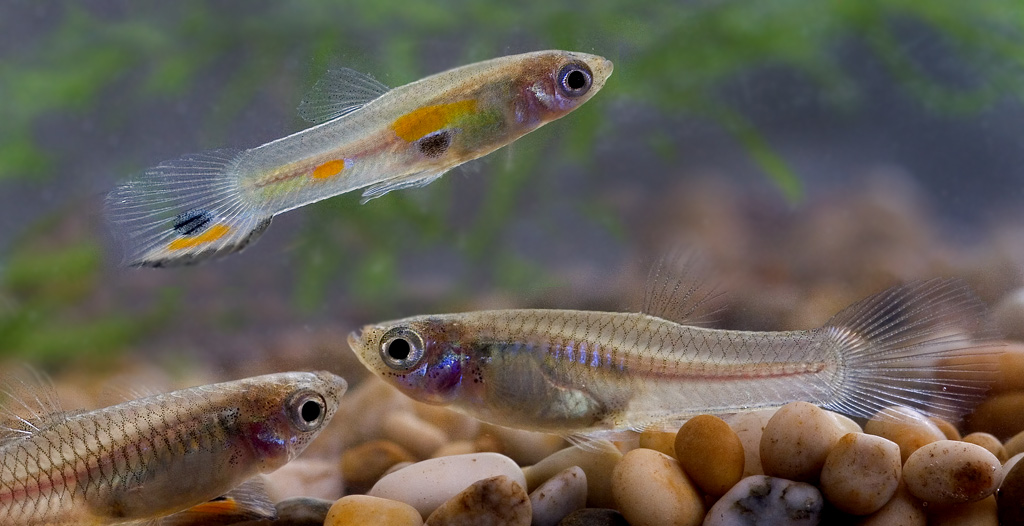
Guppy
Poecilia reticulata
- Temperature
- 17–28 °C
- pH
- 7 – 8.5
- Min. tank size
- 41 L
- Lifespan
- 2-3 years
- Diet
- omnivore
- Care level
- easy
| Scientific classification | |
|---|---|
| Scientific Name: | Poecilia reticulata |
| Family: | Poeciliidae |
| Origin: | Northeastern South America, The southern Caribbean |
| Care Characteristics | |
| Care Level: | easy |
| Diet: | omnivore |
| Max Size: | 6.00 cm |
| Water Type: | freshwater |
| Temp Group: | tropical |
| Temperament: | peaceful |
| Min Group: | 3+ together |
| Varieties: | More colour and tail strains exist than any keeper could catalogue, and new ones appear constantly. Tail shapes are the main division: fantail and delta, the broad triangular tails of most shop fish; veiltail; swordtails, top, bottom or double, where the caudal extends into points; lyretail; roundtail; and the short, wild-shaped spadetail. Colour strains are named by pattern rather than shape — cobra, snakeskin, tuxedo, mosaic, grass, moscow, koi, albino, full-platinum. Show strains such as the half-black and full-red lines are bred to standards and cost many times what a mass-market guppy does. The endler's livebearer (Poecilia wingei) is a separate but closely related fish, smaller and brighter, that hybridises freely with guppies. Many so-called endlers in the trade are already hybrids. Wild-type guppies are still occasionally available and are much hardier than fancy strains, at the cost of the finnage. Buy from a specialist breeder if you can. Mass-produced fancy guppies are the fish most often reported as dying within weeks of purchase, and the cause is usually inbreeding and farm disease rather than anything the new keeper did. |
| Lifespan: | 2-3 years |
Quick Tips
- Bioload:Medium
- Min Tank:41 L
- Substrate:Unfussy, Fine gravel
- Plant Safe:Completely safe
- Filtration:Moderate - gentle filtration like a sponge filter is ideal
Guppy (Poecilia reticulata) is a species of fish in the family Poeciliidae. It is native to Northeastern South America, The southern Caribbean. The guppy is native to north-eastern South America and the southern Caribbean — Venezuela, Guyana, Brazil, Trinidad and Tobago, Barbados, and Antigua and Barbuda — and has since been released across most of the tropical world for mosquito control, often at the cost of native fish. It is one of the most studied vertebrates in biology. The Trinidad populations, where the same species lives above and below waterfalls with and without predators, underpin decades of research into how quickly natural selection can act on colour and life history. Males and females are strikingly different animals. Males reach 1.5–4 cm and carry the colour: splashes, spots and stripes in almost any combination, plus extended fins. Females reach 3–7 cm, are noticeably plainer, and do the reproductive work. It is a livebearer, and it is relentless about it — which is the single most important thing to know before buying one.
Compatibility
- Temperament
- peaceful
- Keep in
- Groups of 3+
- Swims
- middle
- Fin nipper
- No
- Delicate fins
- Yes — keep away from nippers
Species similar to Guppy
Matched on family, then category, then water type