From Aqua Guide, the free encyclopedia
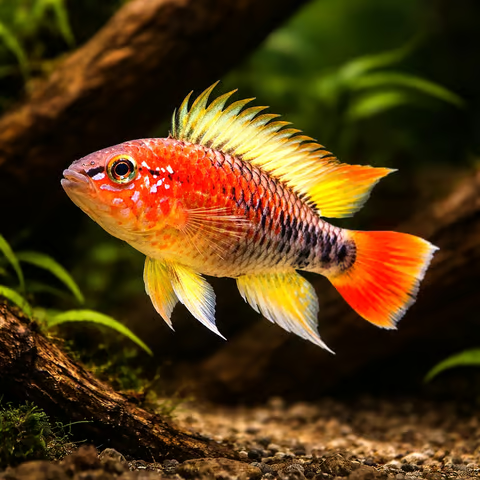
Macmaster's Dwarf Cichlid
Apistogramma macmasteri
- Temperature
- 24–28 °C
- pH
- 5.5 – 7
- Min. tank size
- 41 L
- Lifespan
- 3-5 years
- Diet
- carnivore
- Care level
- moderate
| Scientific classification | |
|---|---|
| Scientific Name: | Apistogramma macmasteri |
| Family: | Cichlidae |
| Origin: | South America (upper Orinoco basin, Colombia) |
| Care Characteristics | |
| Care Level: | moderate |
| Diet: | carnivore |
| Max Size: | 5.50 cm |
| Water Type: | freshwater |
| Temp Group: | tropical |
| Temperament: | peaceful |
| Min Group: | 2+ together |
| Varieties: | This species exists in multiple colour forms, and a gold ornamental strain is widely produced for the trade. Wild forms are catalogued under the DATZ A-number system as A120, A121 and A122, which is how specialist suppliers distinguish collection points across the Colombian llanos. The gold strain is hardier and more widely available but carries much less of the wild fish's contrast. The species belongs to the macmasteri complex, which includes A. viejita — long confused with it in the trade, and much of what was historically sold as viejita was actually macmasteri — along with A. hongsloi and others. Elsewhere in the genus, A. cacatuoides is the hardiest and most widely kept, A. agassizii the most common wild-type, and A. borellii the most tolerant of cooler and harder water. All share the cave-spawning biology and the maternal brood care. |
| Lifespan: | 3-5 years |
Quick Tips
- Bioload:Low
- Min Tank:41 L
- Substrate:Soft sand; caves, leaf litter and planting for territories
- Plant Safe:Plant-safe
- Filtration:Moderate (gentle flow)
Macmaster's Dwarf Cichlid (Apistogramma macmasteri) is a species of fish in the family Cichlidae. It is native to South America (upper Orinoco basin, Colombia). Macmaster's dwarf cichlid is one of the more approachable Apistogramma: a male carries a high red-edged tail and red-trimmed fins over a boldly marked body, and the species is hardy enough that captive-bred stock suits a community tank. Males reach 55 mm standard length and females 40 mm — a size difference that is itself a sexing method. It is endemic to the Colombian llanos, in the Guaytiquía and Metica river basins. Water is the constraint: pH 5.5 to 7.0 and 0 to 5 dGH, which is genuinely soft. The distinction that matters when buying is origin. Captive-bred specimens suit community tanks; wild-caught fish are best kept alone or with small dither fish such as pencilfish, and should not be mixed with other Apistogramma.
Compatibility
- Temperament
- peaceful
- Keep in
- Groups of 2+
- Swims
- bottom
- Fin nipper
- No
- Delicate fins
- No
Species similar to Macmaster's Dwarf Cichlid
Matched on family, then category, then water type