From Aqua Guide, the free encyclopedia
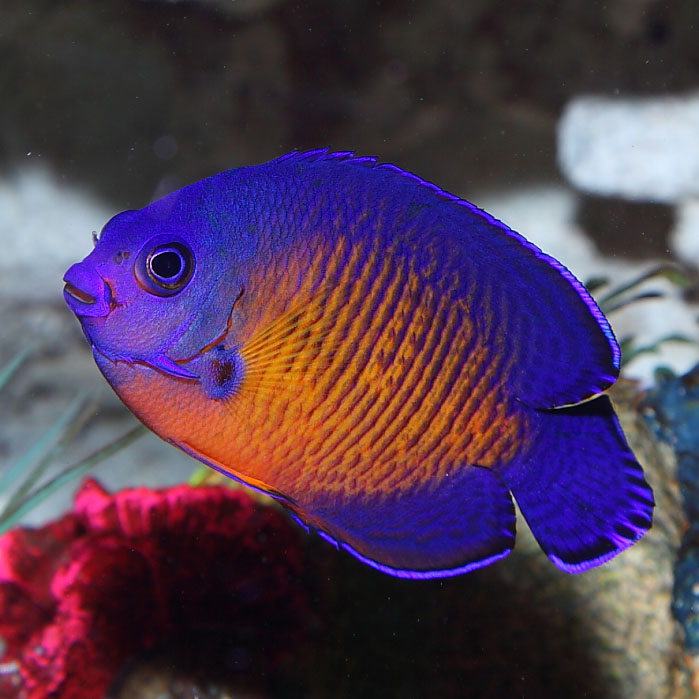
Coral Beauty Angelfish
Centropyge bispinosa
- Temperature
- 24–27 °C
- Salinity
- 1.02 – 1.026 SG
- Min. tank size
- 110 L
- Lifespan
- 5-10 years
- Diet
- omnivore
- Care level
- moderate
| Scientific classification | |
|---|---|
| Scientific Name: | Centropyge bispinosa |
| Family: | Pomacanthidae |
| Origin: | Indo-Pacific reefs |
| Care Characteristics | |
| Care Level: | moderate |
| Diet: | omnivore |
| Max Size: | 10.00 cm |
| Water Type: | marine |
| Temp Group: | tropical |
| Reef Safe: | Reef Safe with Caution |
| Temperament: | peaceful |
| Min Group: | Can be kept alone |
| Varieties: | No cultivated strains — this is a wild-caught fish, and the variation is geographic. Colour differs noticeably across a range spanning East Africa to French Polynesia: Indian Ocean specimens tend toward deeper purple with more extensive orange, while Pacific fish are often darker with finer barring. Neither is a separate species, and both are sold simply as coral beauties. The genus Centropyge contains the dwarf angelfish as a group, and several are common in the trade: C. loricula, the flame angel; C. argi, the cherub angel; C. eibli, Eibl's angel; C. flavissima, the lemonpeel; and C. bicolor, the bicolour angel. All share the harem structure, the protogynous sex change, the grazing diet and the coral-nipping caveat, and none of them should be kept two to a tank. |
| Lifespan: | 5-10 years |
Quick Tips
- Bioload:Low to medium
- Min Tank:110 L
- Substrate:Live rock with algae and grazing surfaces
- Plant Safe:Yes
- Filtration:Moderate to high (mature reef)
Coral Beauty Angelfish (Centropyge bispinosa) is a species of fish in the family Pomacanthidae. It is native to Indo-Pacific reefs. The coral beauty is the dwarf angelfish most people start with, and it deserves the position: hardy, forgiving, widely available and genuinely beautiful, with a dark purplish-blue body crossed by irregular orange bars and bright blue margins on the fins. It reaches 10 cm and ranges right across the Indo-Pacific, from East Africa to French Polynesia, on reefs between 5 and 50 metres and most abundantly near drop-offs. It lives in harems — a single male with several females — and like other Centropyge it is a protogynous hermaphrodite: the most dominant female in a group will change sex to become male if the existing male dies or disappears. The one caveat is corals.
Compatibility
- Temperament
- peaceful
- Keep in
- Can be kept alone
- Swims
- middle
- Fin nipper
- No
- Delicate fins
- No
- Reef
- Reef Safe with Caution
Species similar to Coral Beauty Angelfish
Matched on family, then category, then water type