From Aqua Guide, the free encyclopedia
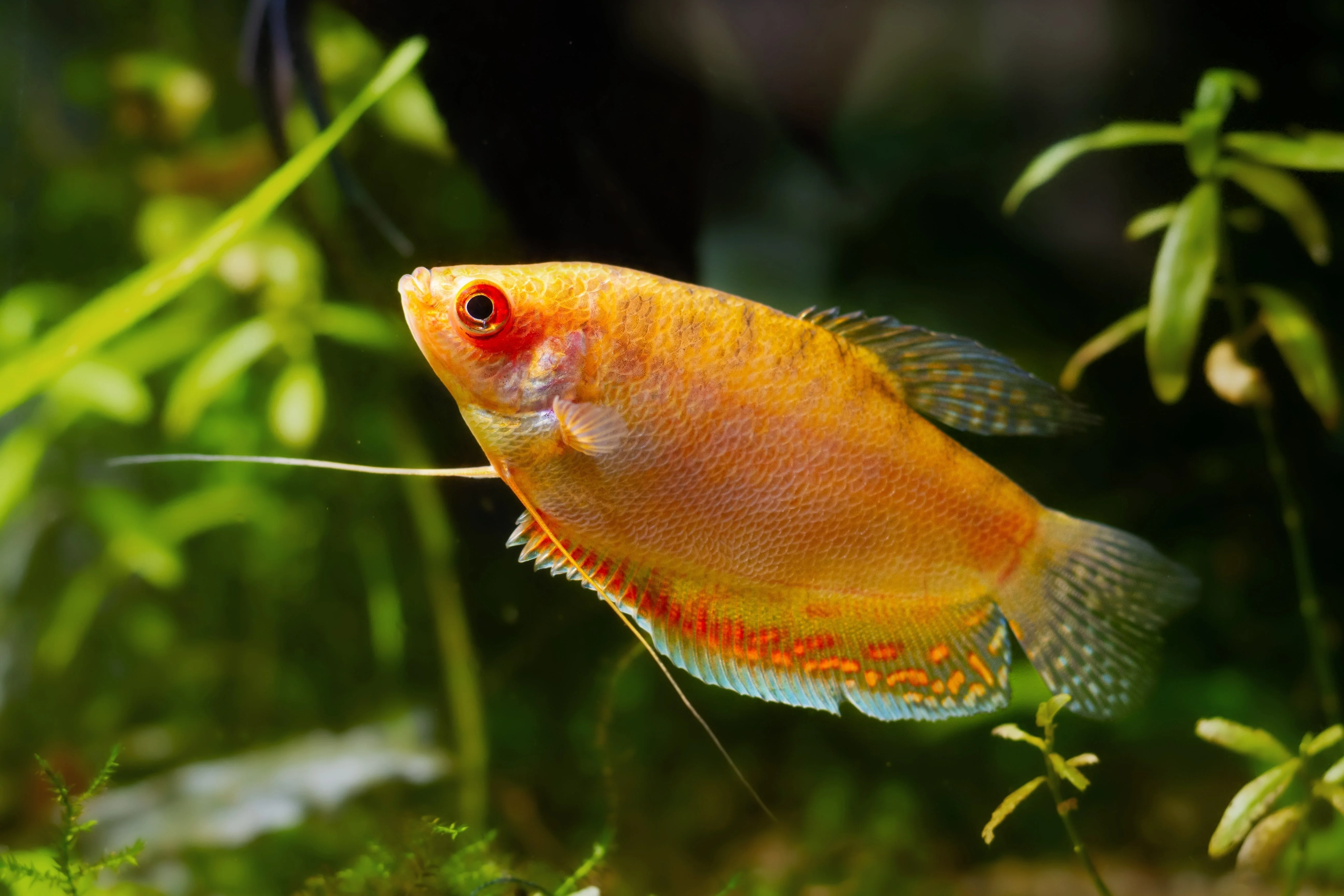
Honey Gourami
Trichogaster chuna
- Temperature
- 22–27 °C
- pH
- 6 – 7.5
- Min. tank size
- 54 L
- Lifespan
- 5 years
- Diet
- omnivore
- Care level
- easy
| Scientific classification | |
|---|---|
| Scientific Name: | Trichogaster chuna |
| Family: | Osphronemidae |
| Origin: | South Asia (India, Bangladesh) |
| Care Characteristics | |
| Care Level: | easy |
| Diet: | omnivore |
| Max Size: | 6.00 cm |
| Water Type: | freshwater |
| Temp Group: | tropical |
| Temperament: | peaceful |
| Min Group: | 4+ together |
| Varieties: | The natural form is a modest fish that becomes spectacular in breeding colour, and several selectively bred ornamental strains exist alongside it. The best known are the red, sunset and golden honey gouramis. Care for all of them is identical to the natural form — these are colour selections rather than fish with different requirements. The sunset strain is by far the most widely sold, and it is worth knowing that a sunset honey gourami is a permanently orange fish rather than one that changes colour with mood. Some keepers prefer the wild form for exactly that reason: the transformation into nuptial colour is part of the appeal, and a strain bred to be orange all the time has traded it away. Sexing the colour strains is harder, because the pattern differences the wild fish relies on have been bred out. Size and body shape are what remain. Two relatives are commonly confused with it. The dwarf gourami (Trichogaster lalius) is larger, more brightly banded and carries the iridovirus risk. The thick-lipped gourami (T. labiosa) is larger again and sometimes sold as a honey gourami, particularly in its own sunset strain. |
| Lifespan: | 5 years |
Quick Tips
- Bioload:Low
- Min Tank:54 L
- Substrate:Dark substrate; planted with floating cover
- Plant Safe:Plant-safe
- Filtration:Low (gentle flow; surface air access)
Honey Gourami (Trichogaster chuna) is a species of fish in the family Osphronemidae. It is native to South Asia (India, Bangladesh). The honey gourami is the fish to buy when someone has told you to buy a dwarf gourami. It is smaller — about 5.5 cm standard length — calmer, and it does not carry the iridovirus problem that dogs its more colourful relative. It comes from slow, vegetated waters across India and Bangladesh. A nuptial male is genuinely striking. Out of condition he is a modest orange-tinged fish with yellowish fin margins; in breeding colour the body and gill covers turn bright orange while the head, the lower front of the body and the spiny rays of the anal fin go dark blue to black. The change is dramatic and it comes and goes with mood. Females are plainer — brownish, noticeably larger than males, with a broad brown stripe along the flank. Like all anabantoids it breathes atmospheric air, and it uses its threadlike pelvic fins as feelers to touch and taste its way around the tank.
Compatibility
- Temperament
- peaceful
- Keep in
- Groups of 4+
- Swims
- top
- Fin nipper
- No
- Delicate fins
- No
Species similar to Honey Gourami
Matched on family, then category, then water type