From Aqua Guide, the free encyclopedia
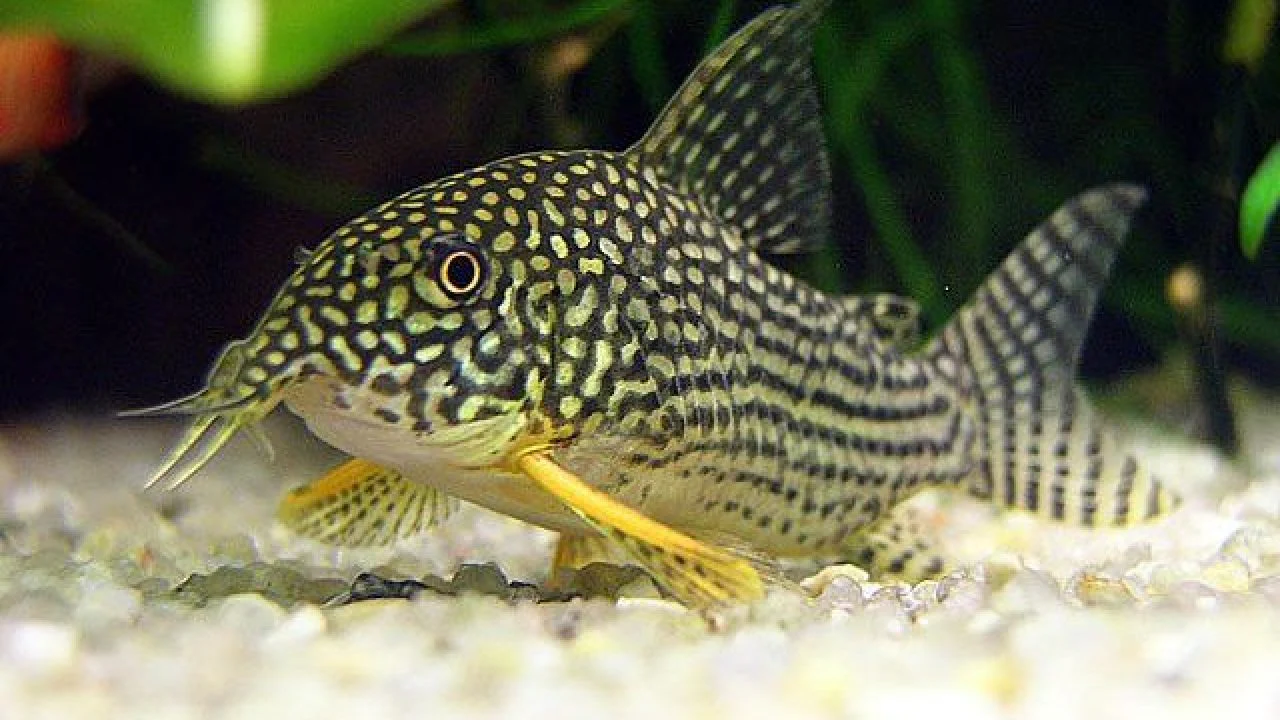
Sterba's Corydoras
Hoplisoma sterbai
- Temperature
- 24–28 °C
- pH
- 6 – 7.6
- Min. tank size
- 75 L
- Lifespan
- 5-8 years
- Diet
- omnivore
- Care level
- easy
| Scientific classification | |
|---|---|
| Scientific Name: | Hoplisoma sterbai |
| Family: | Callichthyidae |
| Origin: | South America (Guaporé river basin, Brazil and Bolivia) |
| Care Characteristics | |
| Care Level: | easy |
| Diet: | omnivore |
| Max Size: | 6.50 cm |
| Water Type: | freshwater |
| Temp Group: | tropical |
| Temperament: | peaceful |
| Min Group: | 6+ together |
| Varieties: | No established colour strains, and the wild pattern is the reason people buy it. Albino sterbai are produced and traded, a pale cream-pink fish with red eyes on which the white spotting is invisible — which removes the entire point of the species for most keepers, though the fish itself is identical in care. Long-finned sterbai appear occasionally and are line-bred rather than distinct. As with every long-finned strain, extended finnage on a bottom-dwelling forager is an impediment. Virtually all fish entering the trade are produced commercially on farms, mostly in Eastern Europe and the Far East, and these captive-bred fish are generally more hardy and adaptable than their wild counterparts. Several similar corydoras are traded alongside it and are separate species with different requirements. Corydoras haraldschultzi looks very like it but has the spotting pattern reversed — dark spots on a pale head rather than pale spots on a dark one — and is regularly sold as sterbai. The julii, trilineatus, panda and bronze corys are all different fish; the panda in particular wants markedly cooler water. If you are stocking a warm tank, check you are buying sterbai and not one of the cooler-water species. |
| Lifespan: | 5-8 years |
Quick Tips
- Bioload:Low to medium
- Min Tank:75 L
- Substrate:Soft sand (essential to protect barbels)
- Plant Safe:Plant-safe
- Filtration:Moderate
Sterba's Corydoras (Hoplisoma sterbai) is a species of fish in the family Callichthyidae. It is native to South America (Guaporé river basin, Brazil and Bolivia). Sterba's cory is the handsomest of the commonly kept corydoras and the most heat-tolerant of them — which has given it a reputation that needs one careful qualification. It comes from the Guaporé basin on the Brazil–Bolivia border and reaches 65 mm standard length. The head is dark with dense white spotting that runs back over the shoulders, the flanks carry pale striping, and the pectoral and pelvic fins are washed with orange. A well-conditioned adult is a genuinely striking fish. Its range is 24–28 °C (75–82 °F), warmer than any other common cory — a panda tops out at 25 °C (77 °F). The qualification: it is routinely recommended as the cory for a discus tank, and discus are kept at 28–31 °C (82–88 °F). 28 °C (82 °F) is the top of this fish's range, not the middle of it. It is the best available option for a warm tank, and it should be kept at the cool end of the discus range rather than the warm end.
Compatibility
- Temperament
- peaceful
- Keep in
- Groups of 6+
- Swims
- bottom
- Fin nipper
- No
- Delicate fins
- No
Species similar to Sterba's Corydoras
Matched on family, then category, then water type