From Aqua Guide, the free encyclopedia
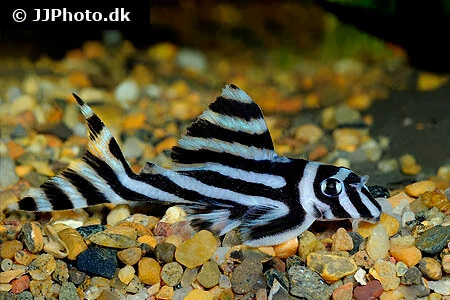
Zebra Pleco
Hypancistrus zebra
- Temperature
- 26–30 °C
- pH
- 6 – 7.5
- Min. tank size
- 110 L
- Lifespan
- 10-15 years
- Diet
- carnivore
- Care level
- difficult
Critically Endangered on the IUCN Red List. That describes the wild population — the criteria cover only wild populations inside their natural range, and captive-bred fish are not assessed. Captive-bred stock exists and is the better choice where you can find it.
| Scientific classification | |
|---|---|
| Scientific Name: | Hypancistrus zebra |
| Family: | Loricariidae |
| Origin: | South America (Rio Xingu, Brazil; protected and export-restricted) |
| Care Characteristics | |
| Care Level: | difficult |
| Diet: | carnivore |
| Max Size: | 8.00 cm |
| Water Type: | freshwater |
| Temp Group: | tropical |
| Temperament: | peaceful |
| Min Group: | Can be kept alone |
| Varieties: | No cultivated strains, and the wild pattern is the entire point — bold black and white striping that varies slightly between individuals and is never improved on by selection. It carries the L-number L046, and L098 refers to the same species. What does vary is the line. Captive populations have been maintained separately for two decades since the export ban, and breeders distinguish their stock by origin and by striping quality. Since no new wild genetics can legally enter, that diversity is finite and worth maintaining — a reason to buy from breeders who track their lines. Several related Hypancistrus are traded and are separate species, not variants. L066 and L333 (the king tiger pleco group), L260 (queen arabesque) and L136 all come from the same region and share the carnivorous diet and cave-spawning habits. Some are also affected by the same dam. Fish sold as "zebra plecos" that are cheap are almost certainly one of the other striped Hypancistrus, or a young L066. Given the price, buy from a known breeder and expect documentation. |
| Lifespan: | 10-15 years |
Quick Tips
- Bioload:Low to medium
- Min Tank:110 L
- Substrate:Sand/smooth gravel; driftwood and many caves; strong flow and oxygen
- Plant Safe:Plant-safe
- Filtration:High (warm, very oxygen-rich water with strong flow)
Zebra Pleco (Hypancistrus zebra) is a species of fish in the family Loricariidae. It is native to South America (Rio Xingu, Brazil; protected and export-restricted). The zebra pleco is the most consequential fish in this guide, and the reason is not its price. It is endemic to a small section of the Rio Xingu in Brazil — the big bend area downstream of Altamira — and nowhere else on earth. The Belo Monte dam has caused a severe reduction in water flow across the entire known distribution range of the species. Not part of it. All of it. It is listed as Critically Endangered by the IUCN, sits in CITES Appendix II, and has been illegal to export from Brazil since 2004, when IBAMA added it to their endangered list. It reaches around 8 cm, is boldly striped in black and white, and is not an algae eater or a wood eater — it is a carnivore. Every legitimate specimen you can buy is captive-bred, and that is the whole point of keeping it.
Legality of keeping and trading this species
- Brazil — Trade prohibited. Under the Brazilian export ban (IBAMA). Brazil prohibits the export of this species, which is endemic to a single stretch of the Rio Xingu and is among the most trafficked Brazilian fish. CITES added it to Appendix II at CoP19 with a ZERO QUOTA for wild-caught specimens, in force from 25 February 2023 — so lawful stock is captive-bred, and a cheap wild-caught fish is evidence of smuggling rather than a bargain.Source · Checked 2026-09-11
This is a summary for reference, not legal advice. Wildlife schedules, noxious-weed lists and import rules are amended, and enforcement varies by state — check the current law and your local authority before acquiring any species.
Listed on CITES Appendix II, which governs how it may be exported and imported. Captive-bred stock still needs the paperwork.
Compatibility
- Temperament
- peaceful
- Keep in
- Can be kept alone
- Swims
- bottom
- Fin nipper
- No
- Delicate fins
- No
Species similar to Zebra Pleco
Matched on family, then category, then water type