From Aqua Guide, the free encyclopedia
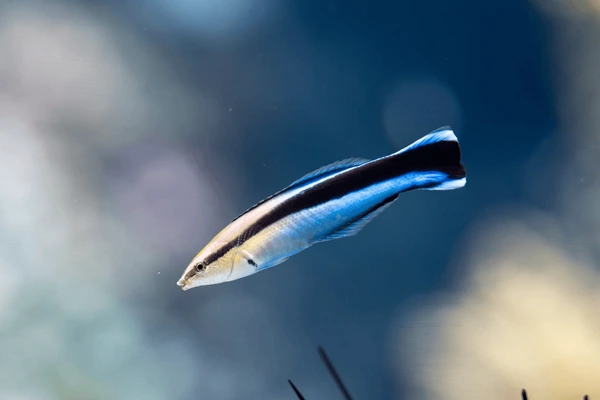
Cleaner Wrasse
Labroides dimidiatus
- Temperature
- 24–27 °C
- Salinity
- 1.02 – 1.026 SG
- Min. tank size
- 200 L
- Lifespan
- 3-5 years
- Diet
- carnivore
- Care level
- expert
| Scientific classification | |
|---|---|
| Scientific Name: | Labroides dimidiatus |
| Family: | Labridae |
| Origin: | Indo-Pacific reefs |
| Care Characteristics | |
| Care Level: | expert |
| Diet: | carnivore |
| Max Size: | 14.00 cm |
| Water Type: | marine |
| Temp Group: | tropical |
| Reef Safe: | Reef Safe |
| Temperament: | peaceful |
| Min Group: | Can be kept alone |
| Varieties: | No cultivated strains — this is a wild-caught fish, and captive-bred specimens are rare though increasingly attempted. Juveniles are black with electric-blue markings and look quite unlike the white, blue and black-striped adults. The mimicry is the notable phenomenon around this species. Aspidontus taeniatus, the sabretoothed blenny, and Plagiotremus rhinorhynchos, the bluestreak fangblenny, both imitate its appearance — the latter mimicking juveniles specifically — in order to approach client fish and bite pieces from them instead of cleaning. A fish that looks like a cleaner wrasse and behaves badly may be one of these. Other cleaner species in the trade include the Caribbean neon gobies of the genus Elacatinus, which perform the same role, are captive-bred, accept prepared foods readily and survive far better in aquaria — they are the sensible alternative. |
| Lifespan: | 3-5 years |
Quick Tips
- Bioload:Low
- Min Tank:200 L
- Substrate:Live rock reef with many fish to clean
- Plant Safe:Yes
- Filtration:Moderate to high (large, busy reef)
Cleaner Wrasse (Labroides dimidiatus) is a species of fish in the family Labridae. It is native to Indo-Pacific reefs. The bluestreak cleaner wrasse is one of the most interesting fish in the sea and one of the least appropriate for a home aquarium. It runs cleaning stations — fixed locations on the reef where other fish queue to have parasites and dead tissue removed — and client fish recognise it by its lateral stripe and its characteristic dancing movement. Recent research indicates the species may demonstrate mirror self-recognition, a cognitive capacity previously attributed to a handful of mammals and birds. That finding alone makes it remarkable. It reaches 14 cm and lives across tropical reefs from the Red Sea to French Polynesia. The problem is that its whole ecology depends on a supply of client fish that no aquarium provides.
Compatibility
- Temperament
- peaceful
- Keep in
- Can be kept alone
- Swims
- middle
- Fin nipper
- No
- Delicate fins
- No
- Reef
- Reef Safe
Species similar to Cleaner Wrasse
Matched on family, then category, then water type