From Aqua Guide, the free encyclopedia
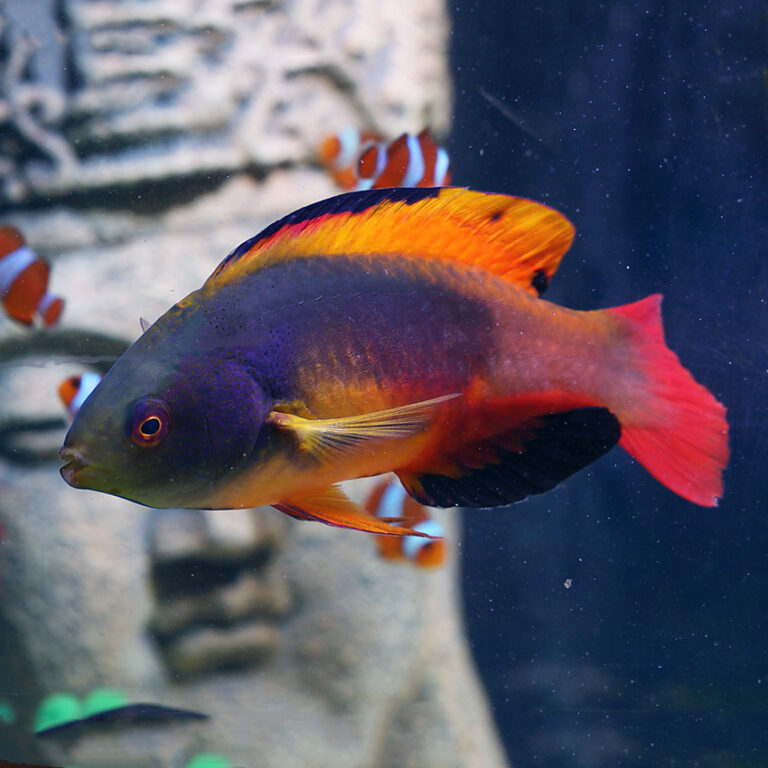
Scott's Fairy Wrasse
Cirrhilabrus scottorum
- Temperature
- 24–27 °C
- Salinity
- 1.02 – 1.026 SG
- Min. tank size
- 280 L
- Lifespan
- 5-8 years
- Diet
- carnivore
- Care level
- moderate
| Scientific classification | |
|---|---|
| Scientific Name: | Cirrhilabrus scottorum |
| Family: | Labridae |
| Origin: | Western Pacific reefs |
| Care Characteristics | |
| Care Level: | moderate |
| Diet: | carnivore |
| Max Size: | 13.00 cm |
| Water Type: | marine |
| Temp Group: | tropical |
| Reef Safe: | Reef Safe |
| Temperament: | peaceful |
| Min Group: | Can be kept alone |
| Varieties: | No cultivated strains — this is a wild-caught fish, and colour varies with origin and, from moment to moment, with display. Fish from the Coral Sea are generally regarded as the most intensely coloured, with a deep red flank and a green-blue posterior; Fijian and Pitcairn specimens differ in the balance of those colours. The species was described in 1989 by Randall and Pyle and named for Sir Peter and Lady Philippa Scott. The genus Cirrhilabrus is large and increasingly popular, with new species described regularly. C. rubrisquamis, C. lubbocki, C. solorensis, C. cyanopleura and the deepwater C. lineatus and C. roseafascia are among those in the trade. All are peaceful, reef safe, haremic, protogynous and inclined to jump. |
| Lifespan: | 5-8 years |
Quick Tips
- Bioload:Low to medium
- Min Tank:280 L
- Substrate:Live rock reef; sand
- Plant Safe:Yes
- Filtration:Moderate to high (reef conditions)
Scott's Fairy Wrasse (Cirrhilabrus scottorum) is a species of fish in the family Labridae. It is native to Western Pacific reefs. Scott's fairy wrasse is a display fish in the literal sense: a male in full flush turns intense red, green and blue, spreads a fan-like tail and flashes at rivals and females, and does it repeatedly through the day. It reaches about 13 cm and comes from the Pacific, from Australia's Great Barrier Reef to the Pitcairn Islands, on coral reefs between 3 and 40 metres. The name honours Sir Peter and Lady Philippa Scott for their contributions to conservation — they organised the dive cruise to the Coral Sea on which the fish was collected and photographed. It is peaceful, reef safe and among the most spectacular wrasses available.
Compatibility
- Temperament
- peaceful
- Keep in
- Can be kept alone
- Swims
- middle
- Fin nipper
- No
- Delicate fins
- No
- Reef
- Reef Safe
Species similar to Scott's Fairy Wrasse
Matched on family, then category, then water type