From Aqua Guide, the free encyclopedia
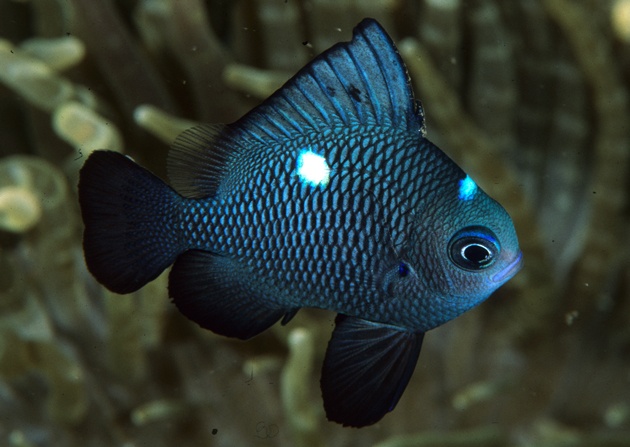
Domino Damsel
Dascyllus trimaculatus
- Temperature
- 24–27 °C
- Salinity
- 1.02 – 1.026 SG
- Min. tank size
- 200 L
- Lifespan
- 6-12 years
- Diet
- omnivore
- Care level
- easy
| Scientific classification | |
|---|---|
| Scientific Name: | Dascyllus trimaculatus |
| Family: | Pomacentridae |
| Origin: | Indo-Pacific reefs |
| Care Characteristics | |
| Care Level: | easy |
| Diet: | omnivore |
| Max Size: | 14.00 cm |
| Water Type: | marine |
| Temp Group: | tropical |
| Reef Safe: | Reef Safe |
| Temperament: | aggressive |
| Min Group: | Can be kept alone |
| Varieties: | No cultivated strains — the wild-type fish is what is sold, and the main variation is with age rather than between populations. Juveniles are jet black with three white spots, one on each flank and one on the forehead; the spots fade progressively, and adults are a plain dark grey-brown. Populations in Fiji show yellow colouration arising from genetic introgression with Dascyllus auripinnis, the golden domino damsel, which is a distinct species. The genus Dascyllus contains several aquarium fish with similar temperaments: D. aruanus, the humbug damsel; D. melanurus, the four-stripe damsel; and D. carneus among them. All become territorial with maturity. For a peaceful schooling damsel, the Chromis species — particularly the blue-green chromis — are the alternative, and they stay peaceful throughout their lives. |
| Lifespan: | 6-12 years |
Quick Tips
- Bioload:Low to medium
- Min Tank:200 L
- Substrate:Live rock and sand reef setup
- Plant Safe:Yes
- Filtration:Moderate (reef conditions)
Domino Damsel (Dascyllus trimaculatus) is a species of fish in the family Pomacentridae. It is native to Indo-Pacific reefs. The domino damsel is bought as a jet-black juvenile with three white spots — the domino pips that name it — and it becomes something rather different. The spots fade with age, the fish grows to around 14 cm, and it becomes notably aggressive, harassing tank mates that were introduced years earlier and claiming territory it will defend against anything, including a hand. It is extremely hardy and adapts readily to captivity, which is exactly why it was once sold in enormous numbers as a cycling fish for new marine tanks — a practice that is no longer defensible. Juveniles shelter within branching corals, urchin spines and large sea anemones, sharing hosts with clownfish.
Compatibility
- Temperament
- aggressive
- Keep in
- Can be kept alone
- Swims
- middle
- Fin nipper
- No
- Delicate fins
- No
- Reef
- Reef Safe
Species similar to Domino Damsel
Matched on family, then category, then water type